

 Feed back
 Privacy Policy
Fullmoon
The lunar cycle consists of eight phases, beginning with the new moon and culminating in the full moon, when the Earth lies directly between the Sun and the Moon. This alignment results in the complete illumination of the Moon’s surface as viewed from Earth. Astronomically, this event is predictable and governed by well-understood celestial mechanics. However, beyond its physical presence, the **moon** has captivated humanity for millennia due to its rhythmic regularity and emotional symbolism. It features prominently in calendars, religious observances, and folklore worldwide.
Scientifically, the full moon plays a crucial role in tidal dynamics through gravitational pull. Culturally, it symbolizes completion, revelation, and transformation. Spiritually, many traditions regard it as a time of heightened energy and introspection. The purpose of this guide is to offer a balanced, **comprehensive** exploration that respects both empirical data and diverse belief systems, ensuring readers gain insights that are **culturally aware**, **objective**, and grounded in reliable information.
One of the most documented aspects of **full moon effects** is its influence on Earth's geophysical systems, particularly ocean tides. Due to the combined gravitational forces of the Moon and Sun aligning during full (and new) moons, higher-than-average "spring tides" occur. According to NASA, these tides can rise up to 20% higher than normal neap tides, impacting coastal ecosystems and maritime activities.
When it comes to human behavior, however, popular beliefs often outpace scientific evidence. Numerous studies have investigated claims linking the full moon to changes in sleep, mood, emergency room visits, and even crime rates. A meta-analysis published in *Psychological Bulletin* (1985) reviewed 37 studies and found no significant correlation between lunar phases and psychiatric hospital admissions, suicides, or violent behavior. More recently, a 2021 study in *Science Advances* analyzing sleep data from over 20,000 individuals across five countries found that participants took about five minutes longer to fall asleep and slept slightly less during the three nights before the full moon—a subtle yet statistically detectable circalunar rhythm.
Despite persistent myths associating the full moon with “lunacy” (from the Latin *luna*, meaning moon), modern epidemiology does not support increased crime or mental health crises during this phase. For example, a 2009 analysis by the U.S. Bureau of Justice Statistics showed no spike in arrests or police calls during full moons. Similarly, a 2016 review in *The Journal of Affective Disorders* concluded there was no consistent link between lunar phases and suicide attempts.
In summary, while **full moon effects** on tides are robust and well-documented, their impact on human psychology remains minimal and largely anecdotal. The findings underscore the importance of relying on **evidence-based**, **accurate**, and **logical** interpretations rather than folklore.

The **full moon spiritual meaning** varies widely across cultures, reflecting diverse cosmologies and value systems. In Eastern traditions, the full moon often signifies enlightenment and communal harmony. For instance, in Buddhism, Vesak—the most sacred day of the year—commemorates the birth, enlightenment, and death of Gautama Buddha and is observed on the first full moon of May. Devotees engage in meditation, lantern lighting, and acts of generosity.
In Hinduism, Purnima (Sanskrit for "full moon") is considered auspicious and marks major festivals such as Guru Purnima, dedicated to honoring teachers, and Sharad Purnima, associated with divine love and fertility. These celebrations emphasize reflection, gratitude, and spiritual renewal.
Western esoteric traditions, including Wicca and modern astrology, view the full moon as a peak of energetic intensity—a time for manifestation, divination, and releasing negative patterns. Full moon rituals may involve candle magic, crystal charging, or energy cleansing practices like smudging. Astrologers often interpret the zodiac sign in which the full moon occurs as influencing emotional themes for the month.
Indigenous communities around the world also hold rich lunar knowledge. The Anishinaabe people of North America recognize 13 full moons per year, each named after seasonal activities (e.g., the "Strawberry Moon" in June). These names reflect a deep ecological awareness and connection to natural cycles.
Common themes across these traditions include **completion**, **illumination**, and **release**—concepts that resonate universally. Presenting these views requires an **objective**, **clear**, and **culturally aware** approach, acknowledging both symbolic depth and regional specificity without appropriation.
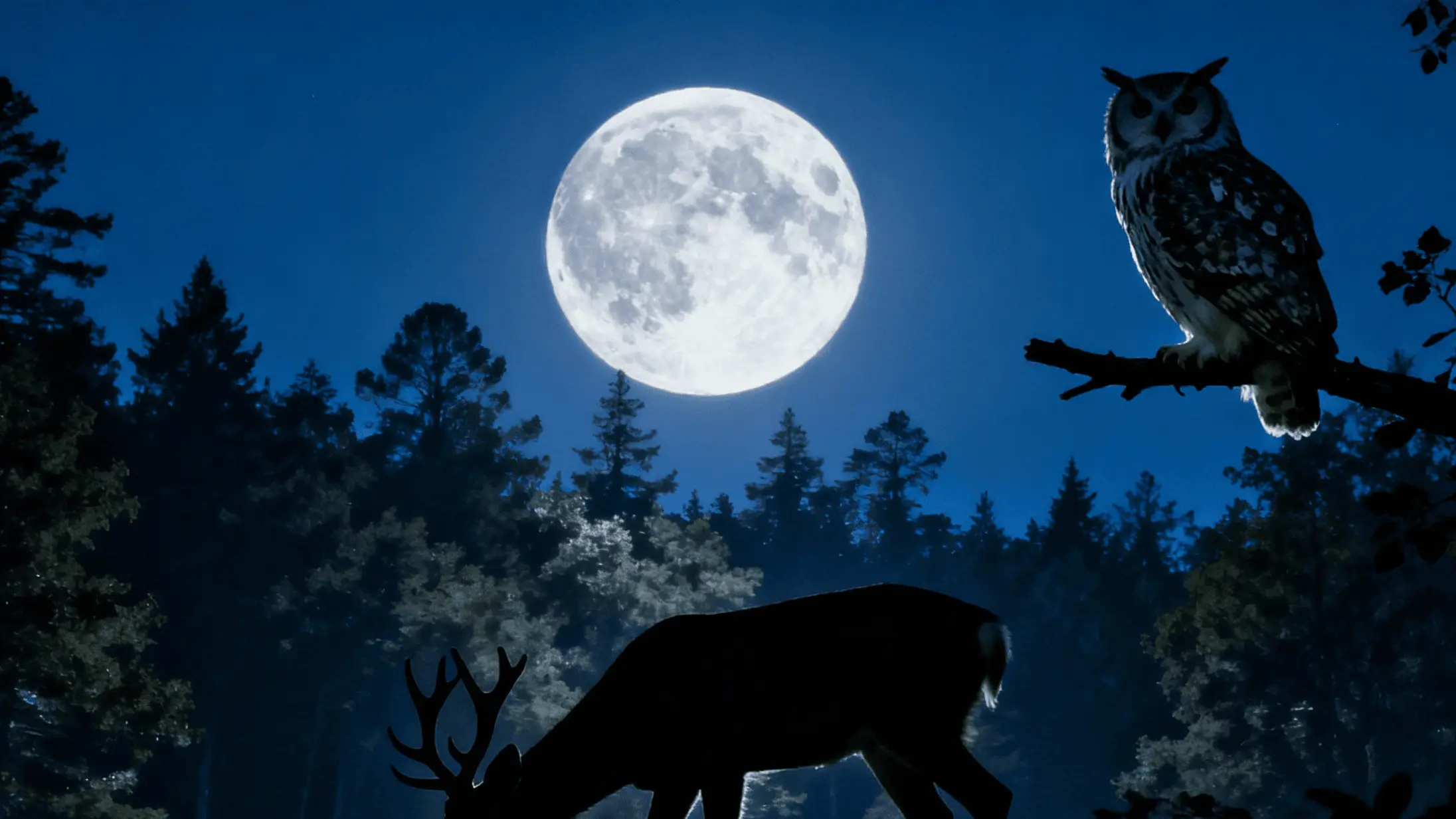
Observations and scientific research confirm that **animals during full moon** periods exhibit notable behavioral shifts, primarily driven by increased nocturnal illumination and circalunar biological clocks.
Nocturnal mammals show altered activity patterns under bright moonlight. Rodents such as deer mice (*Peromyscus maniculatus*) reduce foraging due to higher predation risk, while predators like lions in Tanzania’s Serengeti increase hunting success during full moons, according to a 2013 study in *Animal Behaviour*. The visibility allows them to stalk prey more effectively, though some herbivores respond by becoming more vigilant.
Marine life demonstrates some of the most precise lunar synchronizations. Coral reefs, particularly in Australia’s Great Barrier Reef, undergo mass spawning events triggered by the full moon in spring. Research from the Australian Institute of Marine Science shows that over 130 species release gametes simultaneously within hours of the full moon, maximizing fertilization chances. Similarly, sea turtles—including green and loggerhead species—time their nesting on tropical beaches to coincide with full moons, likely using moonlight cues to navigate ashore.
Birds also respond to lunar cycles. Nocturnal migrants such as warblers and thrushes use moonlight for orientation during long-distance flights. A 2020 study in *Proceedings of the National Academy of Sciences* found that bird vocalizations at night increase significantly during full moons, possibly aiding coordination among flocks.
These adaptations highlight the existence of **circalunar rhythms**—biological cycles synchronized with lunar phases—regulated by internal molecular clocks similar to circadian rhythms. Such **evidence-based**, **accurate**, and **logical** findings illustrate how deeply embedded the lunar cycle is in animal physiology and ecology.
Engaging in a **full moon meditation ritual** can be a powerful practice for mindfulness, emotional release, and personal intention-setting. Rooted in various spiritual traditions, this ritual leverages the symbolic energy of culmination and illumination associated with the full moon.
To begin, prepare a sacred space. Choose a quiet location—indoors near a window or outdoors where the moon is visible. Timing matters: ideally, perform the ritual within 24 hours of the exact full moon phase, which can be tracked via apps like Time and Date or NASA’s lunar calendar. Set an intention—for example, letting go of stress, gaining clarity, or expressing gratitude.
Follow this step-by-step guide:
Incorporate **breathwork** techniques such as box breathing (inhale 4 sec, hold 4, exhale 4, hold 4) to deepen focus. Visualization might include picturing emotions dissolving into moonlight.
For **cultural adaptations**, consider integrating respectful elements from global practices: lighting a diya (oil lamp) inspired by Hindu rituals, practicing silent sitting akin to Buddhist mindfulness, or chanting softly as in Native American ceremonies. Always approach cross-cultural integration with humility and avoid mimicking sacred rites outside one’s tradition.
This **practical**, **clear**, and **culturally aware** method supports emotional balance and self-awareness, making the **full moon meditation ritual** accessible regardless of spiritual background.
Understanding the **full moon** requires a synthesis of science, culture, and personal experience. While **full moon effects** on human behavior remain largely unsubstantiated, its impacts on tides and wildlife are undeniable. Meanwhile, the **full moon spiritual meaning** continues to inspire meaningful rituals across societies, offering psychological benefits through structured reflection and community engagement.
To integrate this knowledge mindfully:
By balancing **objective** analysis with open-minded curiosity, we cultivate a deeper appreciation for the natural world. Continued learning—from peer-reviewed journals to indigenous oral histories—ensures our understanding remains **comprehensive** and **evidence-based**.
Disclaimer: This article contains general information about the moon and related topics for educational purposes only. It does not constitute professional advice in astronomy, psychology, medicine, or spirituality. Readers are encouraged to consult qualified experts before making decisions based on the content herein. The author and publisher disclaim responsibility for any actions taken as a result of reading this material.
Eleanor Thompson
|
2025.11.25


