

 Feed back
 Privacy Policy
Fullmoon
A full moon is defined astronomically as the lunar phase when the Earth lies between the Sun and the Moon in a near-straight alignment, allowing sunlight to fully illuminate the Moon’s surface as seen from Earth. This configuration, known as opposition, results in the Moon appearing as a bright, circular disk in the night sky. The term "full moon" refers not just to visual appearance but also to an exact moment in time—when the ecliptic longitude of the Moon differs from that of the Sun by 180 degrees. This instant can be calculated down to the second using modern astronomical models.
Tracking the Moon has been essential throughout human history. Ancient civilizations such as the Babylonians, Mayans, and Chinese developed sophisticated lunar calendars to guide planting, harvesting, religious festivals, and societal organization. Today, interest remains strong across multiple domains: farmers may still consult lunar cycles through almanacs; spiritual communities hold full moon meditations; and scientists use lunar data for satellite operations and climate research. In 2025, public attention will focus particularly on seasonal names like the Hunter’s Moon and Beaver Moon, which carry historical weight and widespread recognition.
Key lunar events in 2025 include all standard monthly full moons without any rare occurrences such as a super blue moon or total lunar eclipse coinciding with a full moon. However, visibility will vary by geographic location and weather conditions, making local planning important for observers.
The next full moon 2025 will occur on January 13, 2025, at 09:27 UTC. For viewers in different time zones, this translates to:
This first full moon of the year is traditionally called the Wolf Moon, a name derived from early Native American and colonial folklore, referencing the howling wolves heard during cold winter nights. It will be visible globally wherever clear skies permit, rising around sunset and remaining high in the sky throughout the night.
The concept of the “next” full moon is determined by calculating the completion of the previous lunar cycle and projecting forward based on the average synodic month length of 29.53059 days. Astronomers use precise ephemeris data to predict these moments years in advance. These calculations account for slight variations due to orbital eccentricity and gravitational influences from the Sun and other planets, ensuring that published full moon dates 2025 are accurate within seconds.
Below is a comprehensive list of all full moons in 2025, including their exact times in Coordinated Universal Time (UTC) and traditional names rooted in Native American, colonial American, and European seasonal observations:
| Date | UTC Time | Common Name | Origin of Name |
|---|---|---|---|
| Jan 13 | 09:27 | Wolf Moon | Named after wolf packs heard howling in midwinter |
| Feb 12 | 02:53 | Snow Moon | Refers to heavy snowfall typical in February |
| Mar 13 | 17:10 | Worm Moon | Marks the thawing ground and emergence of earthworms |
| Apr 12 | 06:22 | Pink Moon | Named after early spring wildflowers (phlox) |
| May 12 | 18:34 | Flower Moon | Celebrates the blooming of flowers in late spring |
| Jun 13 | 07:19 | Strawberry Moon | Reflects the short strawberry harvesting season |
| Jul 12 | 21:39 | Buck Moon | Indicates when male deer begin growing new antlers |
| Aug 11 | 13:59 | Sturgeon Moon | Named after abundant sturgeon fish in North American lakes |
| Sep 10 | 08:39 | Hunters Moon | Closest full moon to autumnal equinox; aids nighttime harvesting |
| Oct 17 | 05:26 | Hunter’s Moon | Follows harvest; ideal for hunting game under bright moonlight |
| Nov 16 | 03:28 | Beaver Moon | Signals time to set beaver traps before freeze-up |
| Dec 15 | 02:02 | Cold Moon | Denotes onset of winter and longer nights |
Each full moon rises around sunset and sets around sunrise, remaining visible all night. Visibility depends on atmospheric conditions, light pollution, and observer latitude. Apps such as SkySafari, Stellarium, or NASA’s Eyes on the Solar System provide real-time tracking and augmented reality views of the Moon’s position.
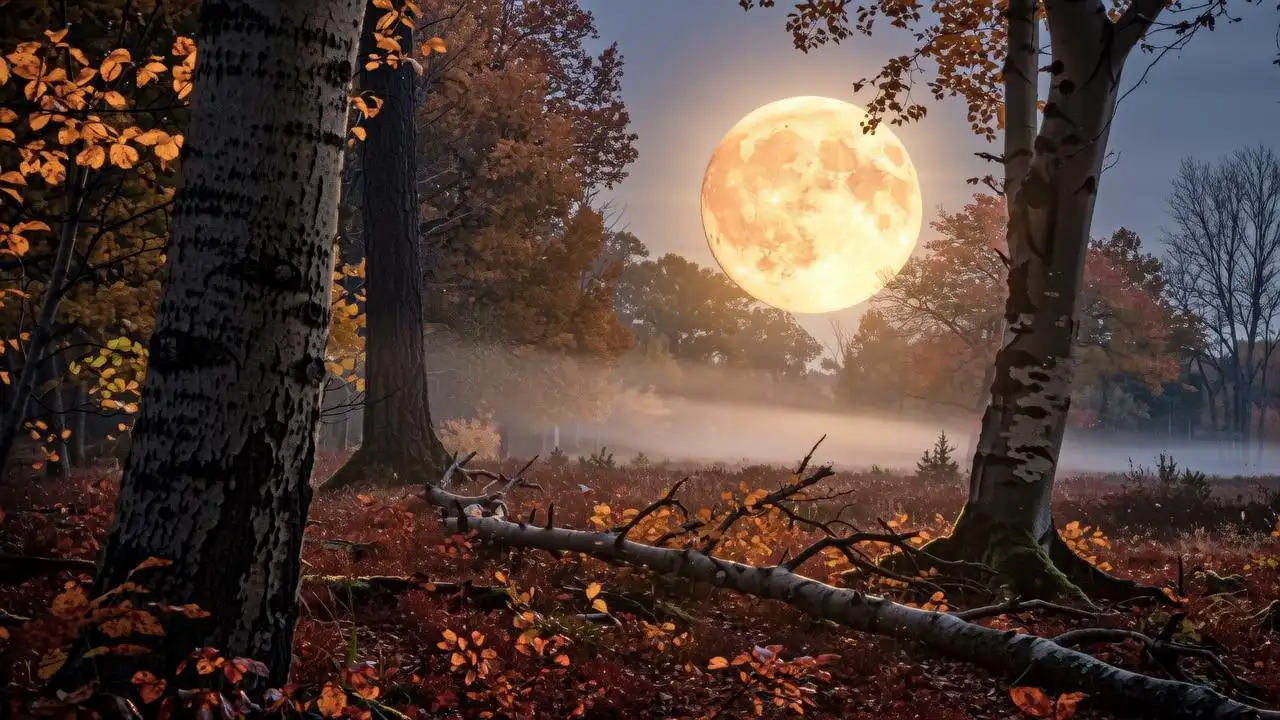
The October full moon 2025 will reach peak illumination on October 17 at 05:26 UTC. For North American observers, this occurs in the early morning hours:
Known as the Hunter’s Moon, this full moon historically signaled the time to hunt and stockpile food before harsh winter months. Unlike other full moons, the Hunter’s Moon rises shortly after sunset for several successive evenings due to a shallower angle of the Moon’s orbit relative to the horizon, providing extended periods of bright moonlight—critical before artificial lighting existed.
Its cultural significance extends beyond agriculture. Indigenous peoples such as the Algonquin used this period for communal hunts, while European settlers adopted the name into colonial calendars. Modern skywatchers appreciate its brightness and low trajectory, often giving it an orange hue when near the horizon due to atmospheric scattering.
To view the October full moon 2025 optimally:
The November full moon 2025 will occur on November 16 at 03:28 UTC, translating to:
Called the Beaver Moon, this name originates from Algonquin tribes who noted that beavers become highly active in building dams and preparing for winter during this time. It was also the traditional period for setting beaver traps to secure warm furs before rivers froze—a practice later recorded by European colonists.
Ecologically, the Beaver Moon coincides with significant seasonal transitions: shorter days, colder temperatures, and animal migration or hibernation behaviors. Its appearance often precedes the first major frosts in temperate zones. While not scientifically classified as a supermoon (when the Moon is near perigee), it may appear slightly larger if its orbit brings it closer to Earth.
Skywatchers should note that the Moon will rise in the east around sunset and remain visible until dawn. Clear autumn skies often offer excellent viewing conditions during this month.
Predicting the full moon 2025 relies on precise understanding of the synodic month, which averages 29.53059 days—the time it takes for the Moon to return to the same phase relative to the Sun as observed from Earth. This cycle forms the basis of lunar calendars and is calculated using complex algorithms incorporating gravitational perturbations, orbital inclination, and Earth’s rotation.
Organizations such as the U.S. Naval Observatory (USNO) and NASA maintain authoritative ephemerides—tables predicting celestial positions—with accuracies within fractions of a second. These institutions use observational data from satellites, radar ranging, and laser reflectors placed on the Moon during Apollo missions to refine predictions continuously.
All official full moon dates 2025 are referenced in Coordinated Universal Time (UTC) to ensure global consistency. Local times are then derived by applying regional time zone offsets and daylight saving adjustments. For example, a full moon at 12:00 UTC occurs at 7:00 AM in New York (EST) and 8:00 PM in Sydney (AEDT).
These standardized methods allow astronomers, navigators, and the general public to coordinate observations and events reliably across continents.
As outlined in this guide, the full moon dates 2025 span all twelve months, beginning with the Wolf Moon on January 13 and concluding with the Cold Moon on December 15. Key highlights include the Hunter’s Moon on October 17, 2025, and the Beaver Moon on November 16, 2025, both rich in cultural heritage and ideal for observation.
For best viewing experiences:
Whether you're a casual observer, photographer, educator, or culturally engaged individual, tracking the next full moon 2025 offers a meaningful connection to natural rhythms and cosmic precision.
By staying informed through reliable sources and embracing both tradition and science, anyone can enjoy the wonder of the Moon throughout 2025.
[Disclaimer] The content related to Moon and others in this article is for reference only and does not constitute professional advice in any relevant field. Readers should make decisions based on their own circumstances with caution and consult professionals with the appropriate qualifications when necessary. The author and publisher of this article shall not be held responsible for any consequences resulting from actions taken based on the content of this article.
James Peterson
|
2025.11.25


